Asian LNG prices to rise amid simmering geopolitical tensions, elevated TTF
Mixed fundamentals in Europe are likely to keep TTF prices near $29/MMBtu for the coming week, as weaker demand is offset by pipeline supply outages. Asian LNG prices are expected to increase in order for the region to remain an attractive destination for flexible Atlantic Basin cargoes despite relatively weak fundamentals. Both price points continue to be supported by ratcheting tensions in the Middle East.
Market & trading calls
European TTF front-month price outlook: Stable, amid mixed market signals. Below-average temperatures in the first half of the week and weaker wind generation are expected to increase gas demand, while disrupted Norwegian supply, persistent geopolitical tensions and competition with Asian buyers for flexible LNG pose further upside risks. However, higher LNG supply and upward temperature revisions towards the end of the week will cap price gains.
Asian LNG front-month price outlook: Slightly bullish, as firm TTF prices, persistent Strait of Hormuz supply risks and the rollover to the higher-priced December contract outweigh softer regional demand fundamentals. Weaker Chinese industrial consumption, stronger South Korean coal generation and elevated Japanese utility inventories continue to limit Northeast Asian spot procurement, while selective buying in India and Southeast Asia provides modest support. Further geopolitical escalation remains the key upside risk, while improving Middle Eastern LNG deliveries and subdued regional demand could cap price gains.
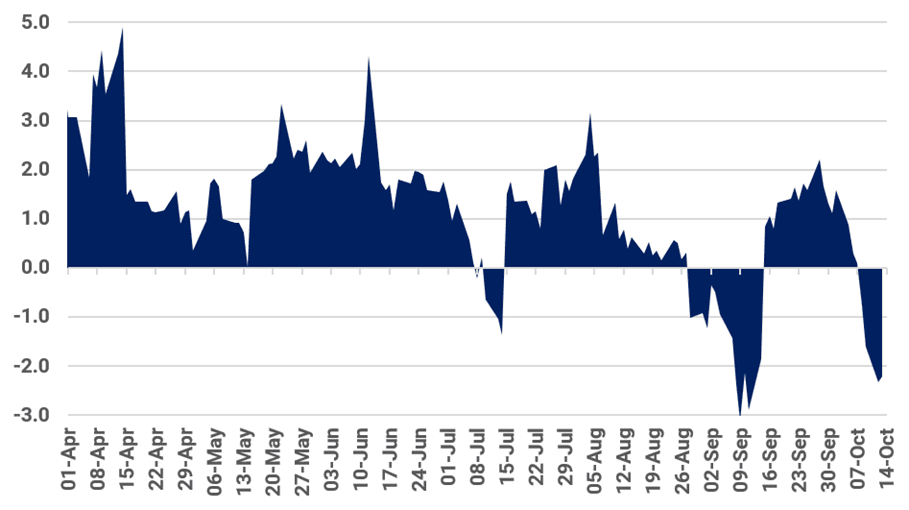
Asian LNG – TTF spread outlook: Set to narrow, as Asian LNG increases slightly amid a stable TTF. The spread flipped w/w, with the Asian LNG trading from a $0.30/MMbtu premium to a $2.21/MMbtu discount as of 14 October.
US Henry Hub front-month price outlook: Stable, as NOAA temperature forecasts for the back half of October show an increasingly mild end to the month, reducing demand expectations in both the residential-commercial and power sectors. This weakening demand outlook will be offset by lower domestic gas production from both voluntary curtailments and from pipeline outages.
Key natural gas and LNG front-month prices ($/MMBtu)
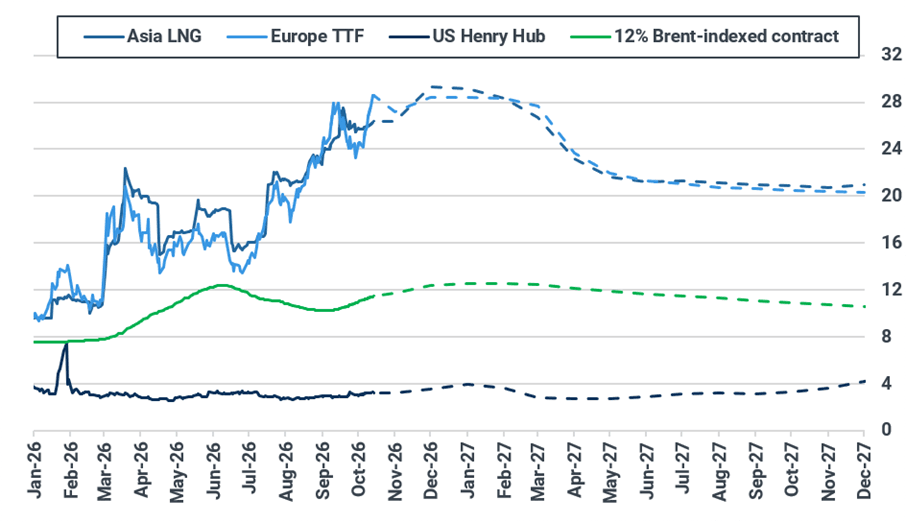
Source: ICE, NYMEX. Brent-indexed price represents 12% slope of 90-day moving average of Brent contract.
Asian LNG-TTF front-month spread ($/MMBtu)
Source: ICE, Kpler Insight
Europe: TTF to remain stable as upward revisions to temperature and higher LNG imports offset lower wind speeds and pipeline supply
The European TTF front-month contract rose from $25.58/MMBtu on 7 October to $28.59/MMBtu on 14 October, an increase of over 11% w/w and reaching its highest level in more than three years. The sharp increase was driven by further geopolitical escalation after a Saudi-backed coalition launched strikes on the Houthis, who subsequently threatened attacks on Saudi energy facilities. However, despite heightened regional tensions and continued attacks on vessels transiting the Strait of Hormuz, Qatari LNG loadings strengthened further, with 13 cargoes loaded at Ras Laffan between 1–13 October, compared with 20 during the whole of September. Four of these 13 cargoes were loaded on vessels with active AIS transponders, while the other nine were verified using satellite imagery, tug tracking, and AIS signals reappearing after Hormuz. In Europe, average temperatures fell slightly below seasonal norms, driving an increase in gas consumption compared with the previous week. However, high wind generation weighed on gas-fired generation across the continent. European storage injections slowed down to 0.14 bcm/d as increases in pipeline supply were more than offset by higher consumption and lower LNG imports, with stocks currently at 74% full. However, Germany and the Netherlands continue to lag behind, with stocks just above 60% full.
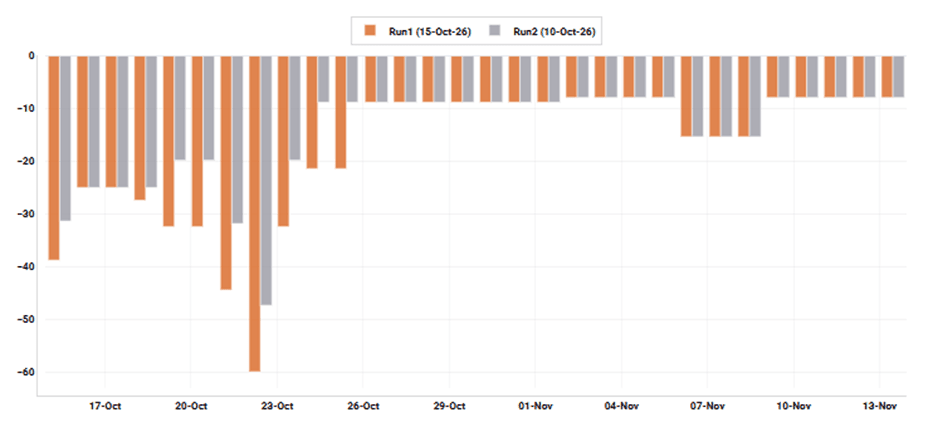
Looking ahead, Kpler Insight holds a steady TTF outlook for next week amid mixed market signals. On the bullish side, temperatures are expected to rise briefly before falling more substantially below seasonal norms, while lower wind generation and increasing competition with Asian buyers for flexible LNG cargoes could provide further support. However, rising Qatari LNG exports despite persistent geopolitical tensions could help offset some of this pressure. Also on the supply side, NCS is currently experiencing outages at the Kristin and Troll fields and the Nyhamna and Karsto processing plants, with a combined impact currently below 0.50 bcm/d but expected to increase briefly next week. Meanwhile, LNG arrivals to Europe are expected to average 2 mt during the week started 12 October, a slight uptick on 1.89 mt from the week before.
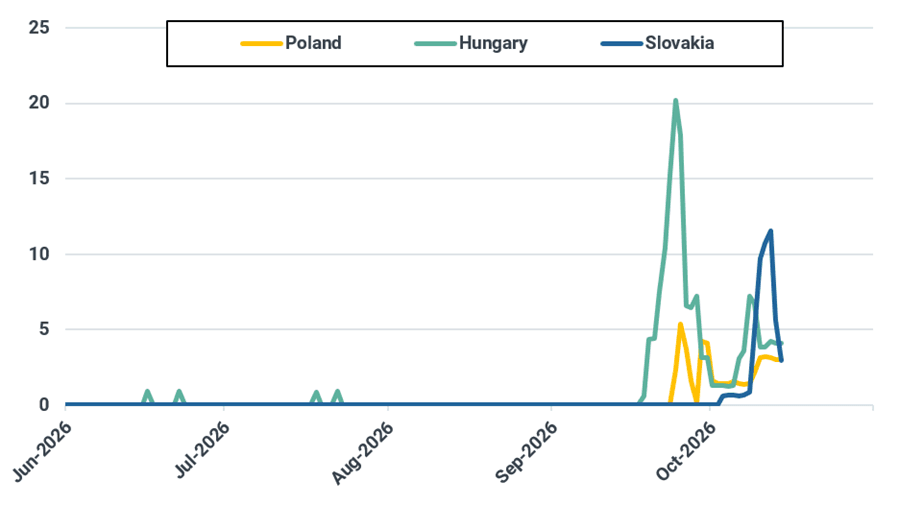
EU-27 net pipeline imports increased by 6.9% w/w to an estimated 2.94 bcm, the highest since the end of August. The increase was driven by higher Ukrainian exports to the EU, particularly via Slovakia. A looser Slovak balance allowed exports to Austria amid planned maintenance at VIP Oberkappel, and higher exports from Austria to Italy at Tarvisio. Higher flows from the East Corridor alongside slight increases in Norwegian exports to the EU more than offset marginal reductions in Algerian and Azeri flows to the EU. Looking ahead, Kpler Insight expects pipeline imports to edge lower into next week, as the heaviest period of planned maintenance at VIP Oberkappel comes to an end, which is likely to weigh on imports from Ukraine via Slovakia. In addition, upward revisions to unavailable capacity at Norway’s Karsto and Nyhamna processing plants and at the Troll and Kristin fields are expected to reduce exports to the continent.
Selected daily Ukrainian flows to the EU (mcm)
Source: ENTSOG
GASSCO scheduled unavailability for fields and processing plants (mcm/d)
Source: GASSCO, on 15 October 2026, 09:00 UTC
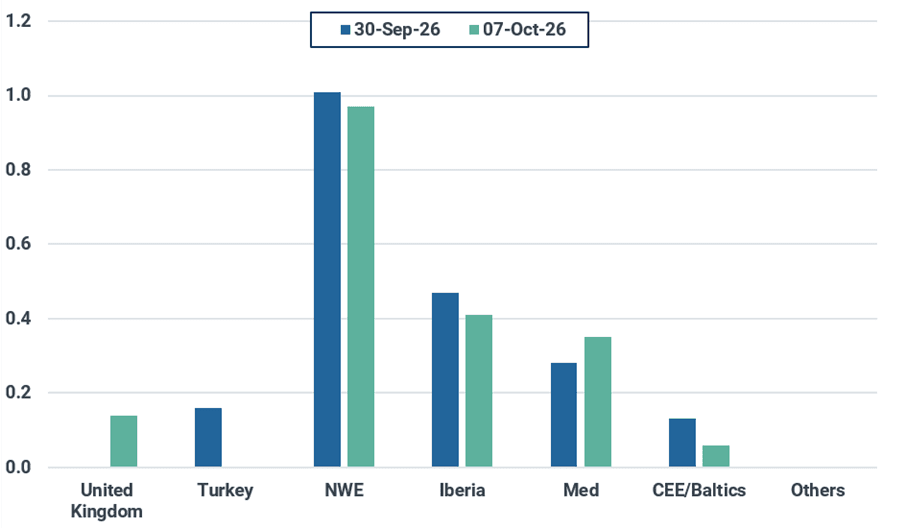
European LNG imports declined by 5.9% w/w to an estimated 1.93 mt, with lower arrivals across most of Europe, except for the UK and Mediterranean markets. Despite ongoing competition for flexible LNG supply from Asia and other importing markets, Europe remained an attractive destination for flexible cargoes, with three LNG cargoes reportedly diverted towards the continent over the past week, compared with just one diverted away. Overall, European LNG sendout edged lower w/w, averaging 300 mcm/d, down from 310 mcm/d the previous week. However, Dutch regasification remained at record-high levels, while strong sendout in France and Spain kept PEG and PVB day-ahead prices at significant discounts to TTF. Elsewhere, Italian and German sendout remained constrained by ongoing terminal maintenance. Looking ahead, LNG imports into Europe are expected to edge higher as regasification economics in Europe remain robust, with the NWE DES price increasing its discount to TTF by $0.08/MMbtu to $0.65/MMbtu as of 14 October.
European weekly LNG imports by region (mt)
Source: Kpler Insight. Data represents week commencing 23/09 and 30/09. NWE=FR, BEL, NL, GER. Iberia=ESP, POR. Med=ITA, HVR, GRE. Baltics/CEE=FI, LT, POL. Others=SWE, MT.
Local distribution consumption (LDC) across 16 EU countries increased by 30% w/w to an estimated 1.67 bcm but remained below levels seen in the past two years. The gains marked the start of the heating season across the continent and were driven by higher gas use in NWE where average temperatures fell by 3°C w/w. Looking ahead, Kpler Insight expects LDC to edge higher next week, as temperatures are forecast to fall below seasonal norms across much of the continent, before recovering towards the end of the week.
EU-16 weekly consumption in the local distribution sector (bcm)
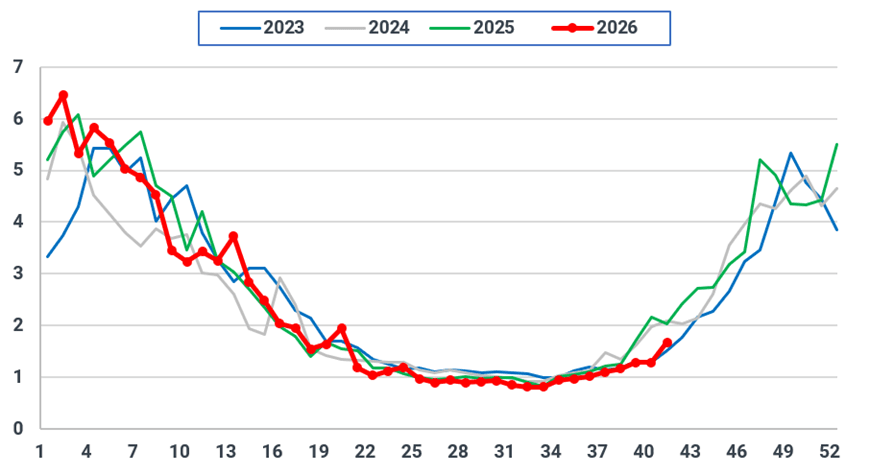
Source: ENTSOG, ENAGAS, Eustream, AGCM, Kpler Insight. The EU-16 perimeter includes AT, BE, DE, CZ, FR, HU, GR, IT, NL, LU, PL, PT, RO, SL, SK, and ES.
Northwest Europe daily average temperature forecast (°C)
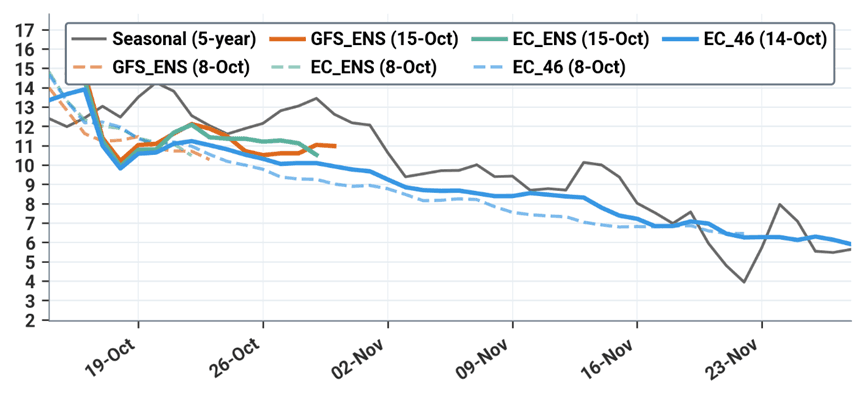
Source: Kpler Insight. Run comparison 15/10 (solid) vs. 08/10 (dotted), 00:00 UTC. Seasonal is a five-year average. NWE includes France, Belgium, Netherlands and Germany.
Southern Europe daily average temperature forecast (°C)
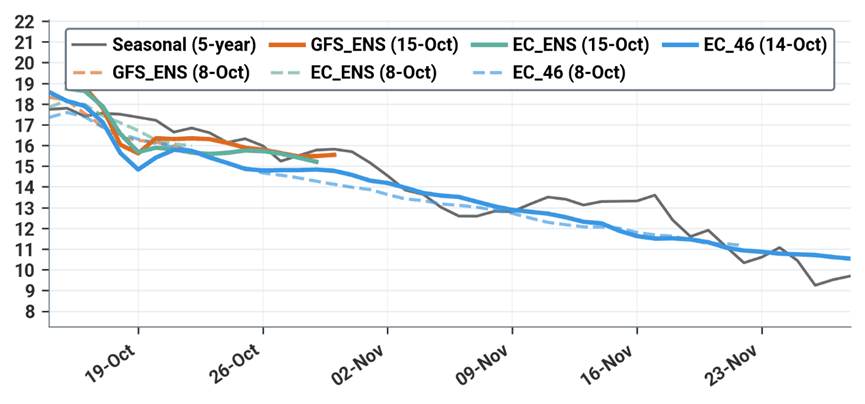
Source: Kpler Insight. Run comparison 15/10 (solid) vs 08/10 (dotted), 00:00 UTC. Seasonal is a five-year average. Southern Europe includes Portugal, Spain and Italy.
EU gas-fired generation declined by 18% w/w to an estimated 6.5 TWh. The decrease came despite a slight increase in power demand and was primarily driven by stronger-than-expected wind generation, which surged by nearly 65% w/w, alongside improved nuclear output. Together, these gains displaced thermal generation from the power mix, weighing on both gas- and coal-fired output. Looking ahead, we anticipate an increase in gas-fired generation as temperatures across the continent are expected to drop and wind speeds are forecast to decline sharply.
EU-25 weekly gas-fired generation (TWh)
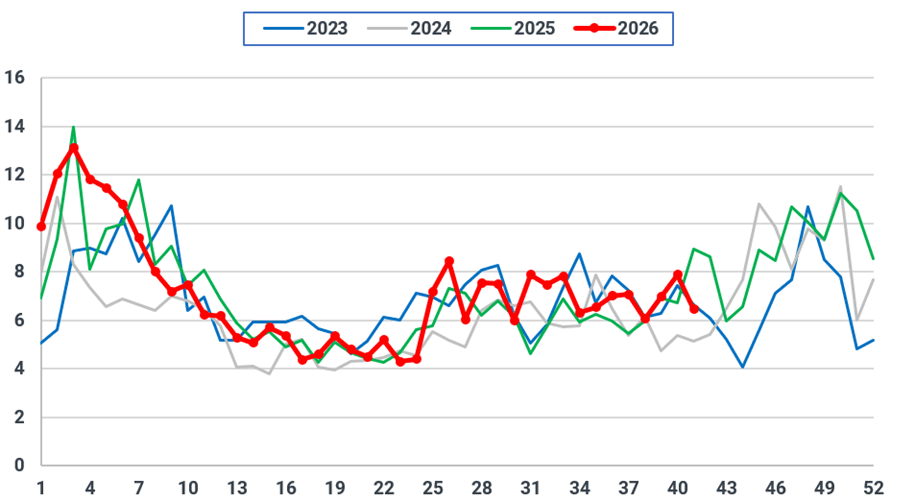
Source: Kpler Power, Kpler Insight.
EU-27 underground gas storage levels rose to 74% full as of 13 October, up 1.1 percentage points w/w. Average daily net injections slowed down last week amid higher gas consumption and reduced LNG supply into the continent. Looking ahead, Kpler Insight expects the pace of injections to slow into next week as overall supply is anticipated to decline amid higher consumption from lower temperatures and underperforming wind generation.
EU-27 daily UGS change since 1 April (bcm)
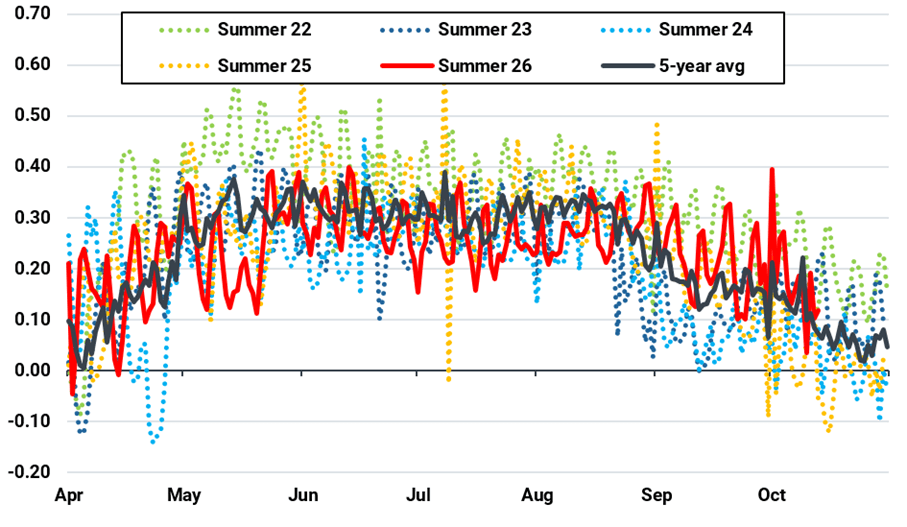
Source: GIE, Kpler Insight. Latest data as of 13 October 2026.

See why the most successful traders and shipping experts use Kpler