Real-time maritime and commodity market intelligence for software & technology firms.


.webp)


350k+
1.2bn+
40+
Product & market intelligence

Analyse maritime markets
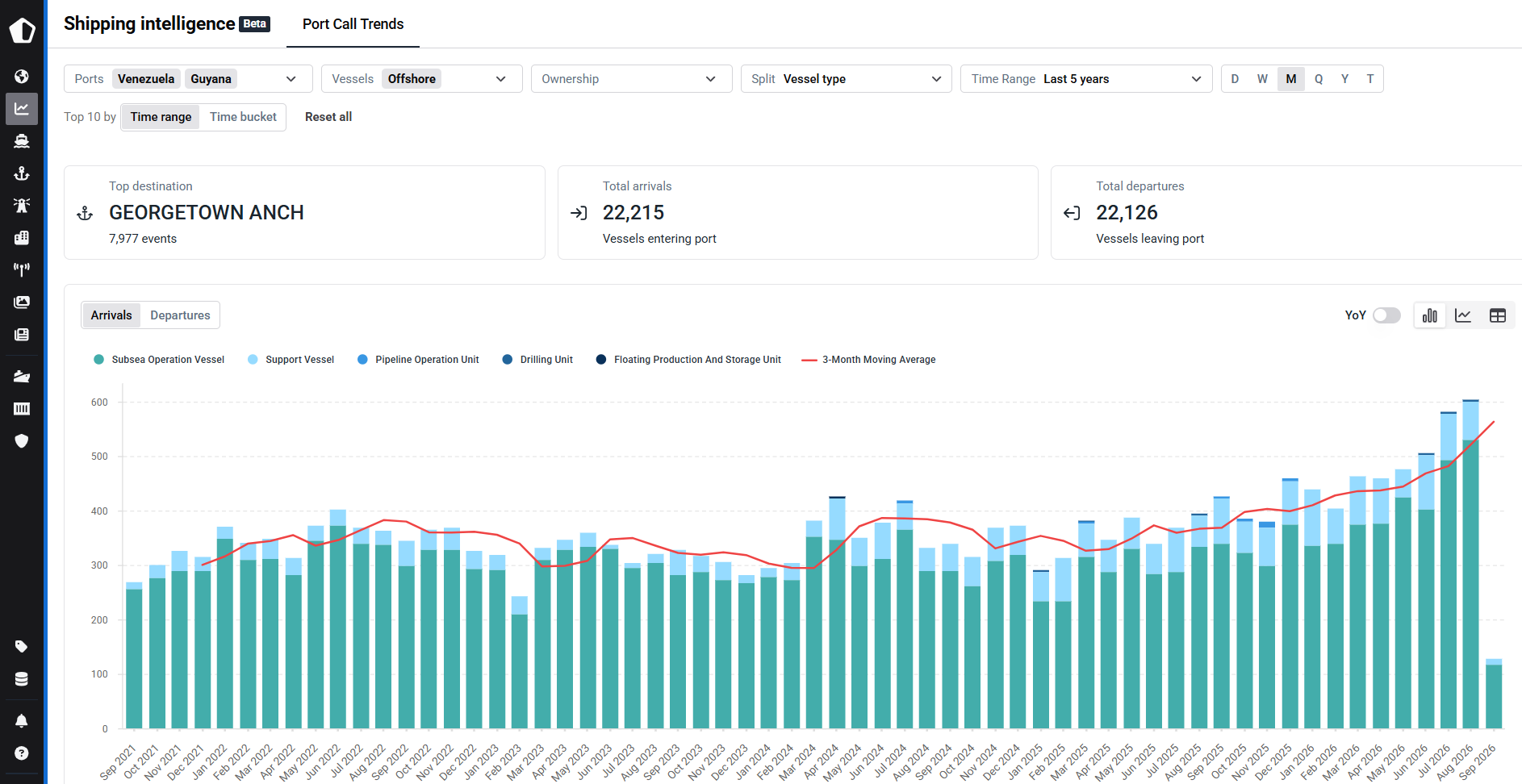
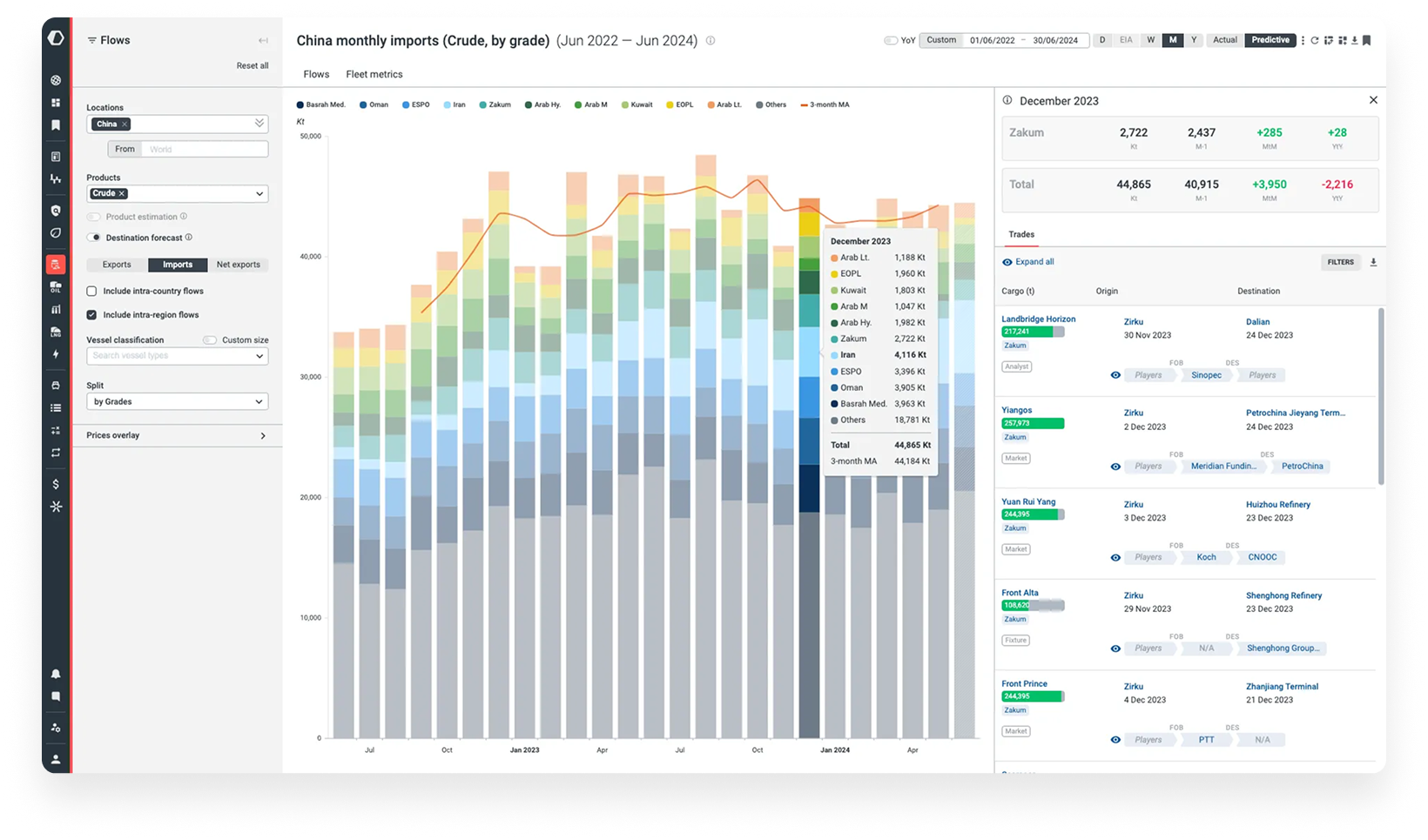
Product and market intelligence teams at maritime technology companies can use historical port activity to investigate the markets, vessel segments and customer groups relevant to their business without first having to transform raw vessel movement data into their own analytical environment. Arrivals and departures can be compared across ports, countries and vessel segments to identify where maritime activity is growing, contracting or changing composition.
Ownership, management and vessel-characteristic filters provide additional commercial context by showing which fleets and companies are active within those markets and how their presence is changing over time. This gives technology companies a self-serve research environment for market assessment, product strategy and commercial planning while allowing technical resources to remain focused on the applications and services they are building.
Identify maritime growth markets
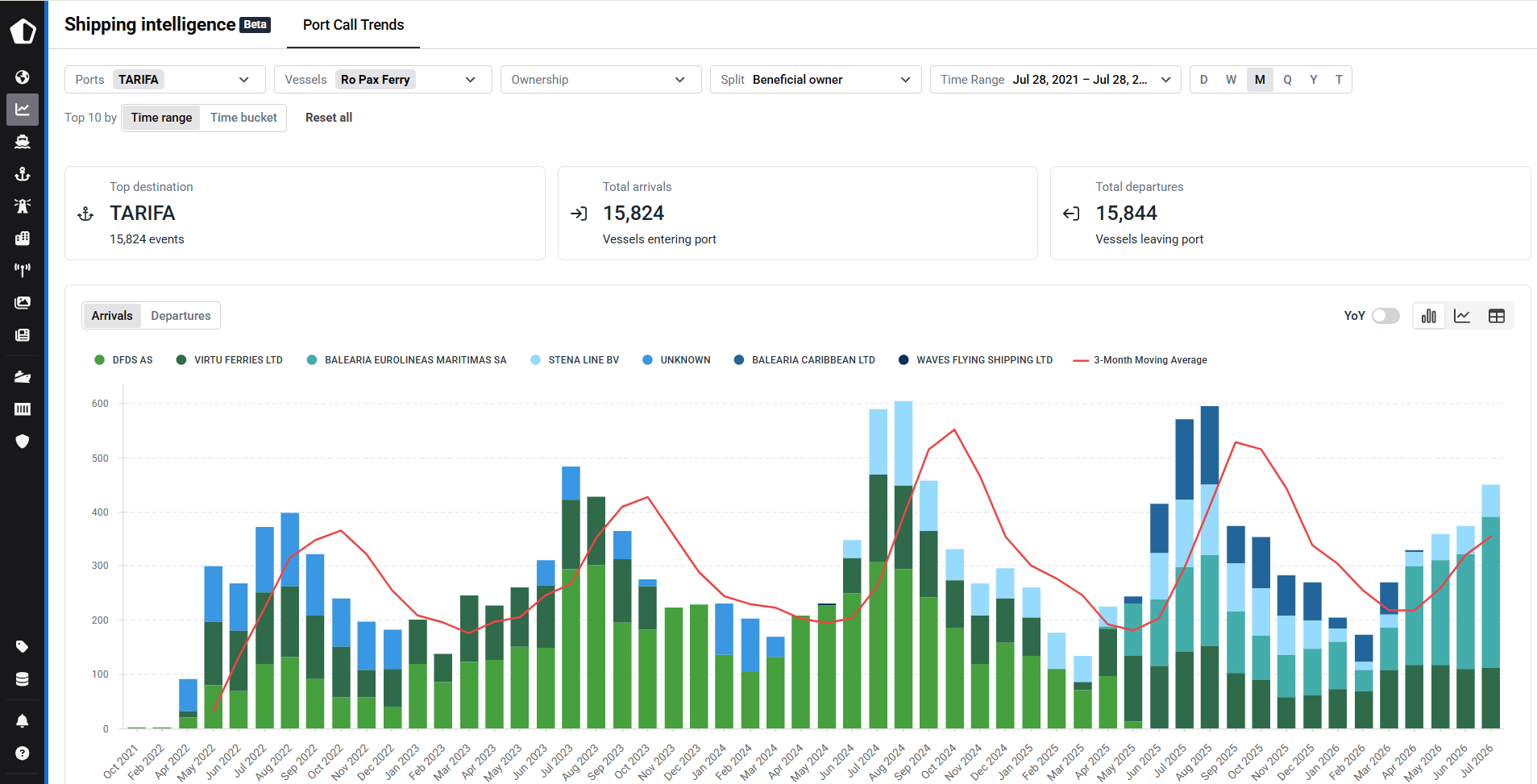
Historical vessel activity can help technology companies understand where the fleets and customer groups relevant to their products are concentrated. Teams can analyse activity by vessel type, size, owner, operator or commercial manager to identify ports and regions where target segments have a significant or growing presence.
Tracking those patterns over time helps distinguish established markets from areas where relevant fleet activity is expanding. Product and commercial teams can use this information to prioritise geographic markets, investigate prospective customer groups and add vessel-based evidence to product strategy and go-to-market planning.

.webp)
FAQ
Yes. Kpler provides APIs and data feeds specifically designed for software and technology firms to embed real-time maritime intelligence into their applications. Whether you're building supply chain visibility tools, logistics platforms, risk management systems, or industry-specific applications, Kpler's APIs deliver vessel tracking, flow data, and maritime intelligence in formats your developers can work with. We partner with tech companies to make maritime data accessible and actionable within your own product ecosystem.
Kpler supports multiple delivery channels to fit your architecture and use case: standard APIs for RESTful integration, Kafka streams for real-time event-driven architectures, NMEA protocol for maritime-standard formats, Snowflake integrations for data warehouse pipelines, and custom extracts for specialized needs. This flexibility means your development team can choose the integration method that works best with your existing infrastructure—whether you're building microservices, data lakes, or maritime-specific applications.
Kpler provides comprehensive maritime datasets you can embed in your applications: real-time vessel tracking and AIS data, historical vessel movements and patterns, flow data (commodities, cargo, trade routes), port activity and congestion data, supply chain visibility intelligence, geopolitical risk signals, and predictive analytics on supply and demand. This breadth means whether you're building a logistics platform, a supply chain risk tool, a financial application, or a maritime-specific product, you can access the maritime data your users need.
Getting started is straightforward: contact our partnerships team to discuss your use case and data requirements, we'll help you select the right datasets and delivery channel for your architecture, your developers get API documentation and sandbox access to test integration, and we provide ongoing technical support as you build. Most integrations launch within weeks, not months. We also work with you to understand how our data can uniquely enhance your product's value proposition to your customers.
Absolutely. Many software and tech companies partner with Kpler to enhance existing products—adding supply chain visibility to logistics platforms, embedding maritime risk signals into financial tools, or integrating vessel tracking into operations software. Others build entirely new offerings powered by Kpler's maritime data. We're actively looking for partners who want to complement their platforms with authoritative maritime intelligence. Your customers get better products, and we expand the ways maritime intelligence reaches the market.