Dry bulk markets confront renewed Hormuz risks and escalating Black Sea disruption
Dry bulk commodity markets remain heavily influenced by geopolitical risks and diverging fundamentals. Iron ore rebounded above $100/t as renewed Hormuz tensions lifted freight costs, although soft Chinese demand, high inventories and slowing steel production continue to cap prices. Coal markets benefited from stronger gas prices and tighter Indonesian supply, while India and Japan faced rising summer power demand. Agricultural markets were dominated by escalating Black Sea disruptions, tighter US grain balances and policy-driven South American biofuel demand. Aluminium eased on macro headwind, while alumina remained weak amid persistent oversupply. Freight markets were mixed, with Black Sea disruption supporting regional rates, while Atlantic and Pacific earnings softened.
Dry Bulk Webinar
- Register and join Kpler’s Monthly Grains Outlook Webinar on 21 July 2026 at 14:00 UTC. We’ll assess how heightened conflict between Russia and Ukraine could impact Black Sea exports during its seasonal peak. Also, following renewed conflict between the US and Iran, we’ll review how trade via the Strait of Hormuz has reacted. With US corn remaining competitive on the global market, we’ll discuss how this shapes the current and upcoming export campaign.
Iron Ore & Steel: Prices reclaim $100/t on Hormuz escalation, but fundamentals signal downside
- Freight rates had just begun to reverse and ease pressure on iron ore prices, when renewed tensions in the US-Iran war pushed iron ore back to $100/t. The most traded iron ore contract, DCE September 2026, rose 2% w/w to close at 759.5 yuan/t on 16 July, while the SGX IODEX 61% Fe August contract was trading up 1.5% w/w at $100.15/t at the time of writing.
- With the Strait of Hormuz under pressure, volatility in freight will continue to feed through into iron ore, even as weak demand and CMRG negotiations point towards a weakening ore price. For context, freight peaked at 18-19% of the delivered price of 62% Fe iron ore in China in May, slipping to just under 17% in June, the highest freight component in the price since late 2021. Any escalation or de-escalation could quickly swing the delivered iron ore price.
- Despite this price bounce, it is evident that market fundamentals are softening. Chinese seaborne iron ore imports fell sharply to 18.01Mt in the week ending 12 July, down 28% w/w and 30% y/y. Shipments from BHP, Vale and FMG fell, while Rio Tinto and Hancock volumes fared slightly better. Heavy rains and extreme heat have slowed construction activity in China. Mounting losses at Chinese steel mills are likely to further keep spot trading subdued. Crude steel production by CISA member mills averaged 2.02Mt in the ten days between 1 and 10 July, down 4% y/y and 3% m/m.
- Iron ore stockpiles reflect the same softening. While port inventory levels remain much higher than last year’s levels, we are now seeing cautious procurement amid squeezed steel mill margins. Price gains remain capped by mounting losses at Chinese steel mills, which are fuelling expectations of further production cuts and weaker near-term demand.
- Global seaborne iron ore exports fell 10% w/w to 31.73Mt in the week ending 12 July, mirroring the pullback in Chinese arrivals. Volumes were down 1% y/y but remained above the five-year average of 30.38Mt. Australian shipments stood at 17.21Mt, down 10% w/w, while Brazil saw its iron ore shipments drop 11% w/w to 7.26Mt. From a supply perspective, several smaller stories are playing out. The workers' strike at BHP's Port Hedland, CMRG's restriction on certain FMG products, and subsequent negotiations with top miners remain key monitorables. On the other hand, weekly cargoes to the Middle East remain subdued under 0.5Mt on Hormuz constraints.
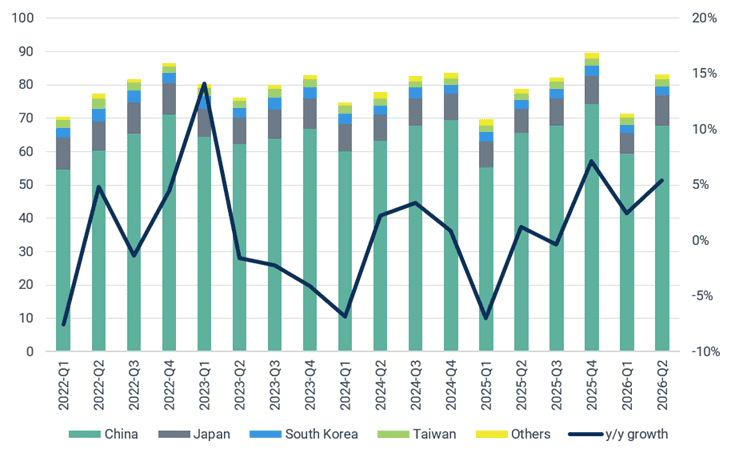
- Against this backdrop, Rio Tinto reported a 7% y/y rise in Q2 Pilbara iron ore sales to 85.3Mt, right at our estimate of 85Mt in the Iron ore miners tracking report, published 1 July. Average pricing at its Pilbara operations improved to $85/t FOB from $83.2/t a year earlier. Construction of Simandou (SimFer) mine and port infrastructure is now over 75% complete. Kpler Insight forecasts for Q2 BHP volumes also tracked closely, with a forecasted 74Mt versus 74.8Mt of actual WAIO production (100% basis).
Rio Tinto’s Pilbara shipments recover in Q2 (Mt)
Source: Kpler
Coal: Coal price outlook improves with gas market strength
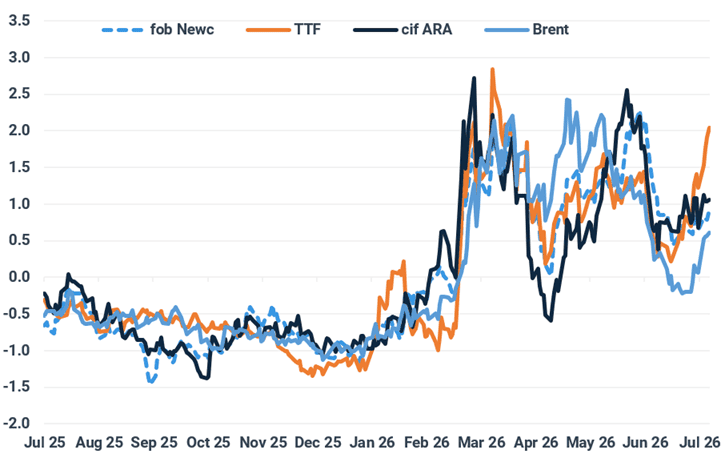
- A renewed escalation of the conflict between the US and Iran, including strikes and the reinstatement of a US blockade and transit fees in the Strait of Hormuz, spiked natural gas prices. This energy supply uncertainty lifted thermal coal prices. European utilities are actively buying forward positions for the fourth quarter, driven by optimism over highly positive generation margins for winter coal burn compared with gas fired generation. Coal inventories in the Amsterdam Rotterdam Antwerp (ARA) hub remain high, but water levels at the Kaub measuring point on the Rhine plummeted to a four year low of 45cm, severely restricting barge deliveries of thermal coal to downstream utilities in Germany. This will limit the upside for coal demand for the short term given high trucking costs into inland Europe compared with barging over the Rhine.
Month-ahead energy commodity contracts (Standardised values)
Source: Enverus, Kpler Insight
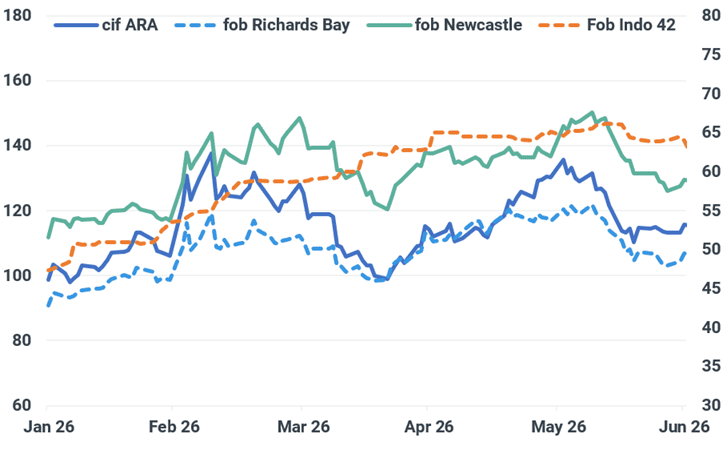
- The Indonesian government raised its domestic coal allocation for state utility PLN to 212Mt, well above the projected requirement of 154Mt, to address recent power blackouts across Java. This prioritisation tightened supply of mid CV coal for the export market, although the impact on the pricing side remains limited given China’s coal burn potential has not materialised for the summer period yet.
Month-ahead coal contracts, fob Indo right-axis ($/t)
Source: Enverus, Kpler Insight
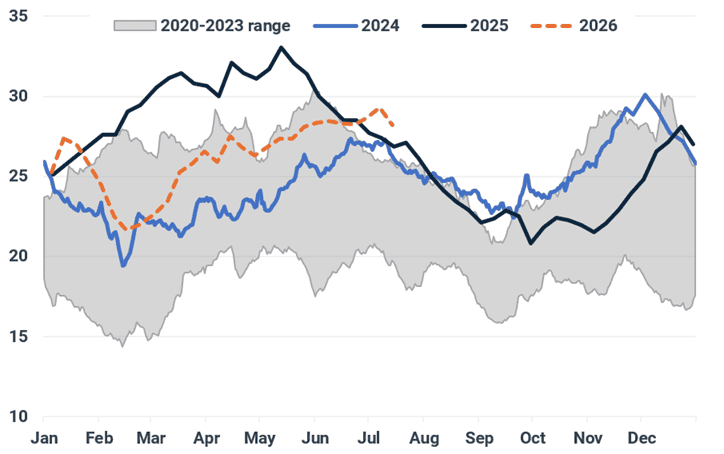
- China’s National Meteorological Center has issued yellow alerts for heavy rain and high temperatures. On 16 July, high temperatures above 40°C were recorded in some areas in eastern Sichuan, western Chongqing and across the Sichuan Basin, Henan, Anhui, Jiangsu, Shanghai, Zhejiang, Jiangxi, Hubei, Hunan, Xinjiang, and Inner Mongolia, though the affected area in southern China will begin to shrink later in the week. As a result of the increased power demand, coal inventories started to shrink in northern China’s Bohai Rim, but still remain elevated compared with 2025 levels. The cooling impact of heavy rains are still offsetting peak power demand to some extent. Coal burn will increase more steeply once dry conditions emerge in China later in the month.
China Bohai Rim coal inventories (Mt)
Source: Sxcoal
- After an exceptionally mild start to the summer season, Japan faces intense heat this week. A heatwave alert has been issued covering 25 prefectures this week. Tokyo faces its first day above 35°C this year, and the latest forecasts suggest the heat will persist through the summer. This surge in cooling demand will lift thermal coal burn at Japanese utilities as air conditioning load pushes power demand higher.
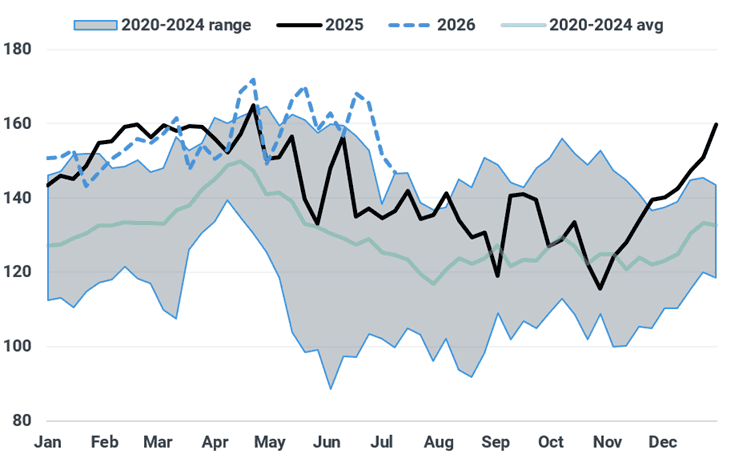
- India's domestic coal stocks fell below 40Mt for the first time since Q2 2025, as record coal burn driven by heatwaves outpaced domestic supply. Utilities have so far offset the drop in stocks with higher domestic production, limiting the need for seaborne cargoes. If stocks drop by another 10Mt, India could need to blend imported material into domestic plants.
India coal-fired generation (GW)
Source: NPP

See why the most successful traders and shipping experts use Kpler

.png)