
Moving metal: navigating costs, congestion, and carbon in the aluminium supply chain
The aluminium supply chain uses both dry bulk carriers and containership freight to move raw materials and products from producer to consumer. This leaves it open to two, sometimes divergent, sets of freight market fundamentals.
Dry bulk carriers are employed to ship bauxite from mines to refineries, as well as alumina for further processing. Aluminium products are generally carried on containerships, although the high cost of container freight has occasionally pushed them onto small dry bulk carriers.
There has been a divergence in the dry bulk freight market this year, with larger Capesize (100k+ dwt) vessels outperforming the smaller ships. Capesizes have enjoyed an average earnings premium of +32% to the smaller Panamax (68,000-99,999 dwt) in the year-to-date. This compares with a long-term average of only +12%.
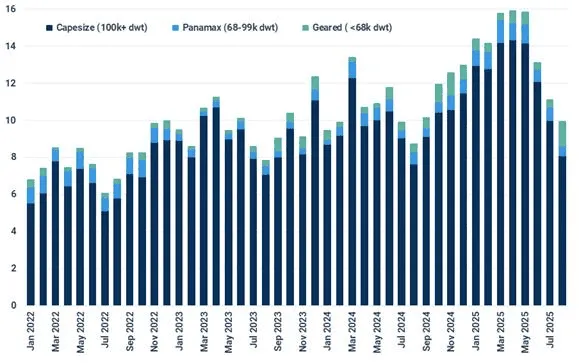
Alongside iron ore, Guinean bauxite exports to China are a key driver of Capesize market strength, with shipments up by 36% y/y to 96.90 Mt over January-August. Volumes are about to start ramping up again following a lull during the rainy season (May-October), and a strong pace of trade is expected, despite policy-driven uncertainty in the Guinean mining sector. By contrast, lower Pacific coal trade has weighed on earnings for sub-Capesize vessels.
Guinean bauxite trade is dominated by Capesize cargoes to China (Mt)
Source: Kpler

See why the most successful traders and shipping experts use Kpler
Gain clarity on dry bulk flows, rates & fundamentals to navigate market shifts precisely