Refining margins to remain supported through H2 as product supply lags crude flows
As crude markets continue to normalise, the focus is increasingly shifting toward refined products. While crude availability is expected to improve over the coming months, refined product supply is likely to recover more slowly, leaving refining margins healthy through H2
Several structural factors underpin this view.
1. Product supply is likely to recover more slowly than crude supply
While crude availability is expected to improve over the coming months, refined product supply is likely to respond with a meaningful lag.
Several factors support this view:
- The Middle Eastern refinery ramp-up will take time. Although refining capacity is coming back online, reaching stable operating rates and establishing export flows is unlikely to happen immediately. We expect the ramp-up in refined product exports to take another 3–4 months, and potentially longer for some assets.
Middle East refinery runs (kbd)
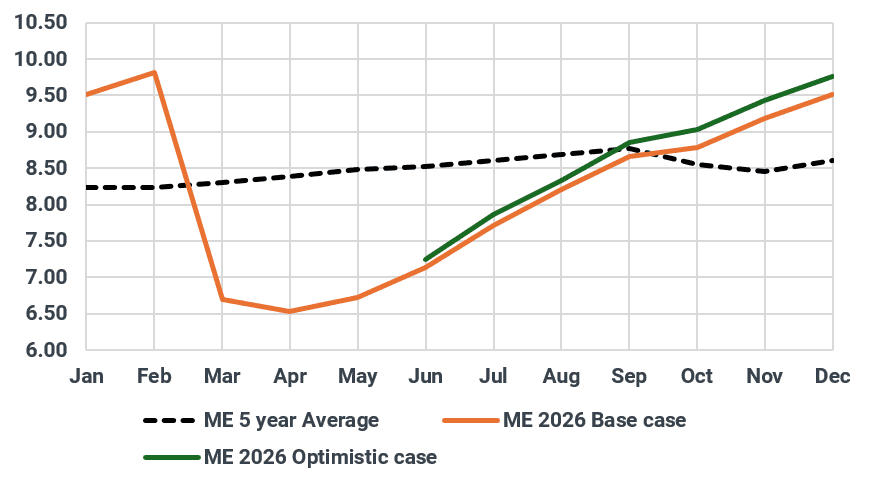
Source: Kpler
- Russian downstream remains structurally constrained. Russian refinery runs have fallen to multi-year lows at 4.1 Mbd in June and are expected to be running around 4.4-5.0 Mbd over July-September, following repeated infrastructure attacks and extended repair work (particularly the recent Moscow refinery attack, where repair works are said to last six months). Even if attacks moderate, residual maintenance requirements are expected to keep refinery throughput markedly below historical levels through H2, limiting incremental product supply.
- China is unlikely to act as the swing supplier. Chinese refinery runs remain subdued at least until August, based on existing programs, with crude imports near decade lows and refined product export quotas continuing to constrain export growth and keep refinery runs in check.
- Autumn maintenance will further tighten supply. Refiners across the US, Europe and India deferred or minimised spring maintenance to maximise utilisation. This points to a heavier-than-normal turnaround season during Q4, reducing refinery throughput just as seasonal maintenance peaks.
- Product inventories. Refined product inventories across the main hubs, including the US (gasoline and diesel), Singapore, Fujairah and ARA, remain relatively low. Limited inventory buffers reduce the market's ability to absorb refinery outages, weather disruptions, unexpected outages, or demand strength, increasing the likelihood of stronger price responses to supply shocks.
- Refinery runs creep. Our current base case assumes global refinery runs average around 81.5 mbd in Q3, rising to around 84.5 mbd in Q4 as crude availability improves and seasonal maintenance winds down. There is, however, an upside to this outlook. Healthy refining margins should encourage refiners with operational flexibility to maximize utilisation. In our optimistic case, capacity creep and higher utilization at existing refineries—particularly in the US, India and parts of Asia—could add a further 700–900 kbd of global refinery runs above our base case.
Taken together, these factors suggest crude markets are likely to normalise faster than refined product markets. While additional crude barrels become available, the supply response in diesel, jet fuel and gasoline is expected to lag, supporting healthy refining margins through H2.

See why the most successful traders and shipping experts use Kpler