The Illusion of Reopening: What if Iran maintains control?
To restore flows to pre-conflict levels, a full reopening of the Strait of Hormuz must occur without Iranian-imposed conditions on the freedom of vessel movement. This remains unlikely under current dynamics. If Iran retains operational control, transit volumes may increase from current levels but will fall short of full normalization.
Market & Trading Calls
- A full reopening of the Strait of Hormuz requires unconditional access. Current dynamics do not support this outcome.
- Iranian control is absolute, limiting upside for transit recovery despite reduced military activity in the Gulf.
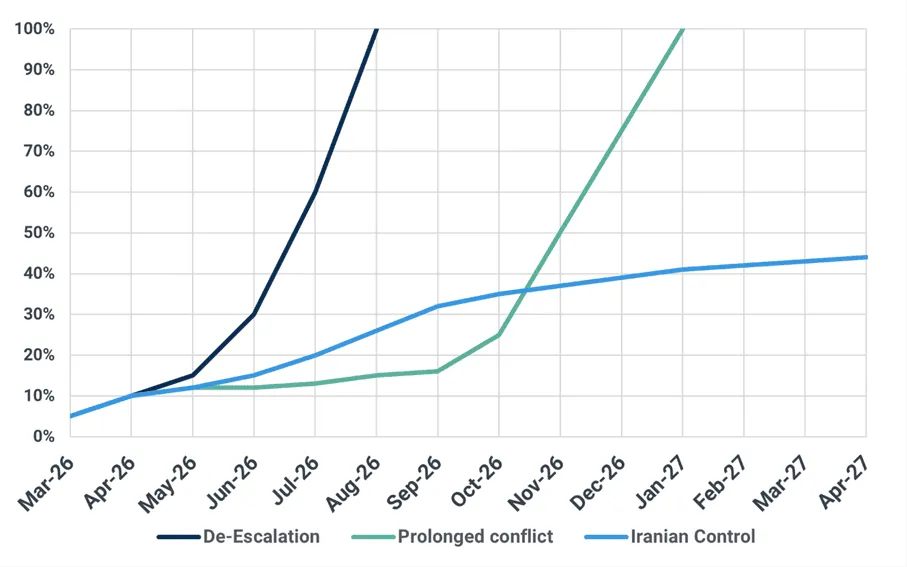
- Under a long-term Iranian Control scenario, transits could rise to 40-50% of export capacity but normalization is not achievable.
- For crude this could be tolerated but other market face persistent supply pressure and price inflation.
Our previous reopening scenarios assumed Iran would become operationally ineffective or would step back to preserve is military capability and trade relationships, allowing a phased normalization. Two months into the conflict, this assumption is weakening. There is growing evidence that Iran may seek to retain strategic control of the Strait for as long as possible. At the same time, the US may tolerate this outcome. A reduction in Iranian attacks and the lifting of US naval pressure would allow flows to increase, easing crude prices and reducing political pressure on the US administration. However, at least for now, the White House continues to maintain a blockade with no timetable for removal.
Phased return of Hormuz transits for tankers (% of MEG export capacity)
Source: Kpler

See why the most successful traders and shipping experts use Kpler