

The US Driver Does Not Have a 18.4c/gal Problem
A federal gas tax holiday is once again being discussed as gasoline prices approach $5 per gallon, but despite repeated attempts since 1993, Congress has never approved a suspension of the tax. Even if passed, an 18.4 cent reduction would do little to solve a gasoline market being driven by structurally tight refined product balances, rapidly declining inventories, and a global supply disruption tied to the Strait of Hormuz.
The gas tax holiday is more political theater than economic solution. It allows lawmakers to appear responsive without addressing the real problem
A federal gas tax holiday remains unlikely to pass. Congress must approve any suspension, and despite pushes in 2000, 2008, and 2022, lawmakers have never enacted one.
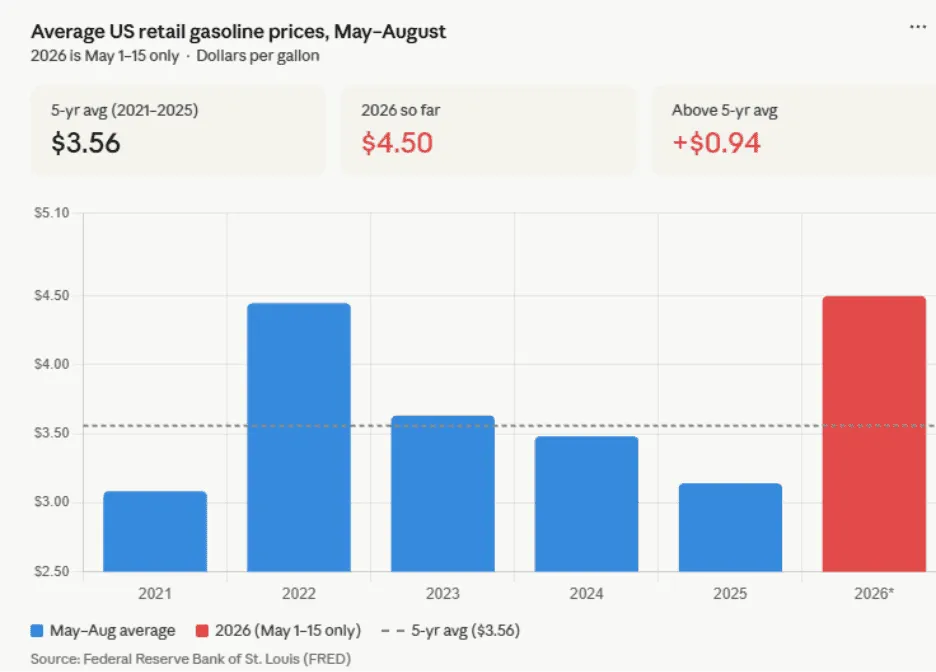
An 18.4 cent tax cut does little to solve a $4.50 gasoline problem. Even with a full pass through, which is unlikely, gasoline prices would still remain well above the five year summer average of roughly $3.56 per gallon.
The US Driver doesn’t have a 18.4c/gal problem
The idea of a federal gas tax holiday tends to reappear whenever gasoline prices surge sharply, particularly during periods of geopolitical disruption. This is now the fourth major time the idea has surfaced since the federal gasoline tax was established in 1993, following previous pushes in 2000, 2008, and 2022. Yet despite repeated political support during periods of high gasoline prices, Congress has never approved a suspension of the tax.
Now, in 2026, the idea has returned once again as nominal US gasoline prices approach $5 per gallon heading into the peak summer driving season. The latest push is tied directly to the Iran conflict and the closure of the Strait of Hormuz, with multiple bipartisan proposals circulating in Congress, including bills from Senators Josh Hawley and Mark Kelly. Some proposals would suspend the tax for 90 days, while others would extend through the end of summer or longer. President Trump has publicly endorsed the idea, while Energy Secretary Wright has also expressed support.
Despite the political momentum, Congress would still need to approve any suspension of the federal gasoline tax. The president cannot unilaterally pause the tax because taxation authority rests with Congress, which remains one of the key reasons a federal gas tax holiday has never actually been implemented.
But the reality is that the American consumer does not have an 18.4 cent per gallon problem. The American consumer has a $4.50 increasing to a $5.00 per gallon problem.
Even under the most optimistic scenario where consumers receive the full benefit, gasoline prices would still remain materially above what Americans have become accustomed to paying during recent summers. The average summer gasoline price over the past five years was roughly $3.56 per gallon. An 18.4 cent reduction does little to meaningfully change the affordability problem consumers are facing today, nor does it change the reality that US inventories are increasingly being drawn into the global market to offset shortages abroad.

See why the most successful traders and shipping experts use Kpler