Ukraine's drone campaign pushes Russian refinery runs to 21-year lows
Russian refinery crude runs have fallen to around 3.80 mbd in July-to-date, the lowest level in well over two decades, as sustained Ukrainian drone attacks continue to disrupt the country's downstream sector, with refinery downtime and attacked capacity standing at around 4.3 mbd in July-to-date. Looking ahead, Kpler expects Russian refinery runs to remain largely subdued through Q3, with only a limited recovery as continued drone strikes and ongoing repairs constrain refinery operations.
Market & Trading Calls
- Bearish for Russian refinery runs and product exports: Continued drone strikes will keep refinery runs subdued, delaying restarts and limiting fuel exports.
- Bullish crude exports: Reduced refining leaves crude available for export.
- Bullish middle distillate cracks: Lower Russian diesel exports continue to tighten Atlantic Basin balances.
Ukraine's drone campaign against Russia's downstream sector has become increasingly extensive, degrading both refining capacity and operational capability. Since August 2025, at least 25 Russian refineries have been affected by drone strikes, with attacks impacting crude distillation units, secondary processing units—including FCCs, hydrocrackers, catalytic reformers and hydrotreaters—as well as storage tanks, pipelines and other critical logistics infrastructure. Damage to these assets often requires broader inspections and integrity checks before operations can resume, extending outages and delaying restarts. As a result, refinery disruptions have increasingly constrained both crude processing and on-spec transportation fuel production.
Russian refinery operations (kbd)
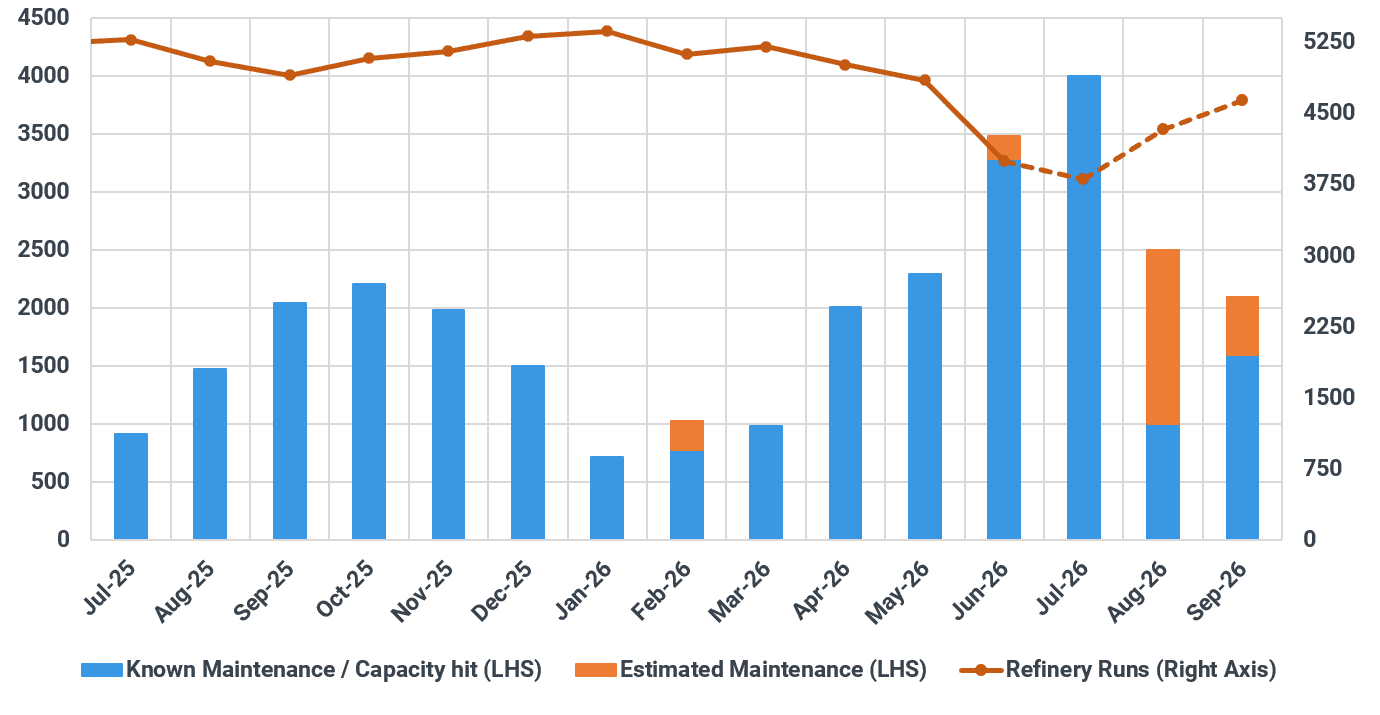
Source: Kpler and IIR
The cumulative impact has been a sharp increase in refinery outages. As of mid-July, refinery downtime and attacked capacity stood at around 4.3 mbd, representing roughly 58% of Russia's refining capacity, with an estimated 1.5–2.0 mbd of processing capacity effectively offline. Higher utilisation at unaffected refineries has only partly offset these losses, leaving Russian crude runs at around 3.8 mbd in July-to-date, the lowest level in more than two decades. Kpler expects runs to recover modestly to around 4.3 mbd in August as maintenance eases, although continued drone strikes leave risks firmly skewed to the downside.
Russian Refinery Runs Since 2006 (kbd)

Source: Kpler
The implications extend well beyond refinery runs. Russia is transitioning from one of the world's largest exporters of transportation fuels to a potential importer of selected products. Rather than supplying the global market, persistent refinery disruptions are increasingly creating incremental demand, providing structural support to global refining margins and product (Gasoline and Mid-distillates) balances.

See why the most successful traders and shipping experts use Kpler