


Russian wheat exports constrained following Ukrainian attacks
Continued Ukrainian attacks on Russian vessels in the Sea of Azov have led to an indefinite suspension of trade through the sea. As a result, one-third of Russian wheat exports may become bottlenecked depending on how long the suspension lasts. Rival exporters, such as the EU, may find short-term demand. Retaliatory attacks pose a significant threat to already limited Ukrainian export capacity.
Russian export capacity restricted
On Friday, Russia temporarily suspended shipping through the Sea of Azov and the Kerch Strait following Ukrainian attacks on several vessels, including tankers, bulkers, and tugboats. Currently, it is not known when the suspension will be lifted, and local reports suggest both ports in Rostov and Taganrog are no longer taking grain deliveries. Russia has since retaliated, including heightened strikes across the Odessa Oblast, a key region for Ukrainian exports.
The Sea of Azov is significant for Russian exports
All Russian grain trade originating from the Sea of Azov would transit through the Kerch Strait. Given the shallow water ports, the purpose of these vessels is mostly for transhipment, which typically occurs on the Black Sea side of the Kerch Strait at Taman or the Kavkaz anchorage. Some of these coaster vessels also deliver to nearby destinations in the Mediterranean and Black Seas, mainly to ports in Türkiye.
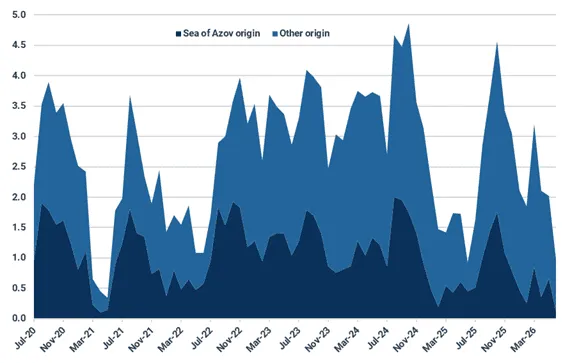
Despite the relatively smaller cargoes, the volume of shipments that originate in the Sea of Azov account for approximately one-third of seaborne Russian wheat exports. At its peak, monthly exports out of the Sea of Azov can account for over 1.5 Mt of wheat, which can be close to the same volume seen by the largest exporting port Novorossiysk. However, monthly exports usually trend lower by a greater extent as the marketing year progresses, seeing it lose export share.
Seaborne Russian wheat exports by origin (Mt)
Source: Kpler
Therefore, the timing of this event coincides with the seasonal peak of exports and will have a stronger impact than if this had occurred in the second half of the marketing year. For wheat, which is the predominant commodity affected, from harvest in July until Oct-Nov, exports depend on full capacity utilisation across all Russian ports in the region. This includes Kavkaz anchorage, which is the second busiest grain export ‘port’, after Novorossiysk. Loss of capacity utilisation at Kavkaz cannot be made up elsewhere, and each day of the suspension will subtract from Russia’s exports in Q3.
A slowdown in Russian or Ukrainian Black Sea grain exports would put further downward pressure on earnings in an overtonnaged Black Sea and Mediterranean Handysize market. Vessel availability there has consistently exceeded the year-ago level, and it was hoped that Russian wheat chartering would help to clear out some of these ships.

See why the most successful traders and shipping experts use Kpler


.webp)






