
The third phase of the conflict: Governing the Strait
Military power may reopen the Strait of Hormuz, but it cannot restore the commercial confidence on which global trade depends. As the old model of freedom of navigation gives way to a new governance framework, the rules governing the world's most important maritime chokepoints are beginning to be rewritten.
The Third Phase of the Conflict: Governing the Strait
The first phase of this conflict began in June 2025, with a renewed campaign in February 2026, and focused primarily on Iran's nuclear capability and regime change. When hostilities resumed in February, Iran closed the Strait of Hormuz, shifting the conflict into a second phase centered on restoring freedom of navigation and reopening the Strait of Hormuz.
The second phase culminated in the Memorandum of Understanding (MOU). Its objective was straightforward: restore the pre-war operating model of open commercial navigation. The agreement, however, demonstrated that the conditions which had made that system possible had fundamentally changed. Rather than sharing a common vision for reopening the Strait, the United States and Iran held fundamentally different views about how it should operate after the signed MOU. Those differing views quickly reignited into military confrontation.
Iran appears to view the arrangement as preserving its authority over commercial transit. The United States, by contrast, sought a return to the pre-war status quo. Those competing visions have ushered the conflict into a third phase. The pre-war operating model has broken down and what replaces it will shape not only the future of the Strait, but the future of global commerce.
The evidence is already visible. Neither side is advocating for a simple return to the previous system. Iran has sought to retain authority over commercial transit, while the United States has publicly discussed imposing security fees on cargo moving through the Strait. Although the proposals differ substantially, they share one important characteristic: both assume that commercial transit will operate under a new governance framework rather than the informal system of freedom of navigation that existed before the conflict.
The debate has therefore shifted from restoring the old order to designing a new order that replaces it.
The Limits of Rerouting
Much of the discussion surrounding the Strait of Hormuz focuses on oil. That is understandable given that approximately one-fifth of global petroleum supply transits the Strait. But as the table below illustrates, oil is only one component of the Strait's strategic importance.
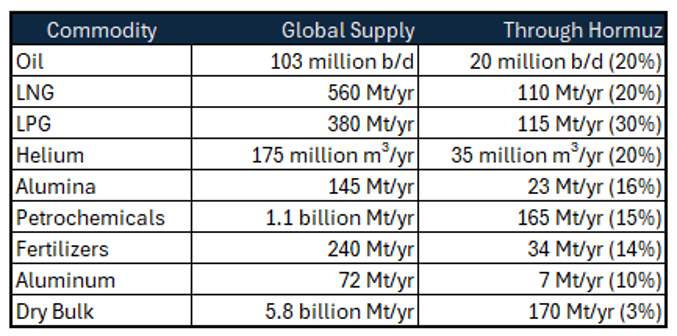
Unlike crude oil, many of these supply chains cannot realistically be rerouted. They depend on fixed export infrastructure, geographically concentrated production and specialized industrialized facilities. Increasingly, the same is true for refined petroleum products.
If the world's supply chains cannot realistically reroute around Hormuz then they must restore confidence in transiting through it. That reality makes governance the defining challenge of Phase Three.
Military deterrence can suppress conflict but it cannot restore commercial confidence. Markets require predictable rules, transparent governance and institutions capable of enforcing them. History repeatedly follows the same pattern: as commerce becomes more valuable and disruption more costly, institutions emerge to reduce uncertainty. Marine insurance evolved into Lloyd's of London. International trade standardized commercial obligations through Incoterms. Global shipping operates under internationally recognized standards for navigation, safety and communications. In every case, the objective was the same: replacing uncertainty with predictable governance.
Restoring confidence in Hormuz therefore requires more than reopening the Strait. It requires an operating framework built on transparent rules, standardized procedures and an institution capable of administering them.
That is why the debate over a Hormuz toll has been widely misunderstood. A toll is more than a revenue mechanism. It is a governance mechanism. It creates an administrative authority, establishes standardized commercial procedures and finances the security architecture that protects one of the world's most important trade corridors. The debate, therefore, should be about who governs the Strait.

See why the most successful traders and shipping experts use Kpler